
Blog · Published 11 September 2026
Education in the age of AI
For a long time, school rewarded the child who could remember the most: dates, formulas, vocabulary lists. That skill still matters but it is no longer enough.
AI can retrieve facts, draft an essay, and solve a worksheet in seconds. If a child's main job is to store and repeat information, they are training for a contest the machine already won. The question for parents and teachers is not whether AI belongs in learning. It is what we ask children to practise once recall is cheap.
What should grow instead
Creativity. The useful work is inventing a question, a game, a story, a way of seeing a problem that nobody assigned. Creative kids do not wait for a worksheet. They try something, notice what is boring or broken, and change it.
Critical thinking. A fluent answer is not the same as a true one. Children need to ask: does this make sense? What is missing? Who benefits if I believe this? Can I check it another way? That habit is what keeps AI a tool instead of an authority.
These are not soft extras around the "real" curriculum. They are the curriculum that still belongs to humans.
Where most tools go wrong
A lot of "AI for education" is a faster worksheet: more drills, a chatbot that gives the answer, a score that goes up. That can feel productive. It often trains the opposite of what we need: speed, compliance, and trust in the first output on the screen.
Kids also cannot grow those skills in a vacuum of ads, dark patterns, and data they cannot see. If a product is optimised for time-on-screen, it will not be optimised for judgement.
How dodi is built for this
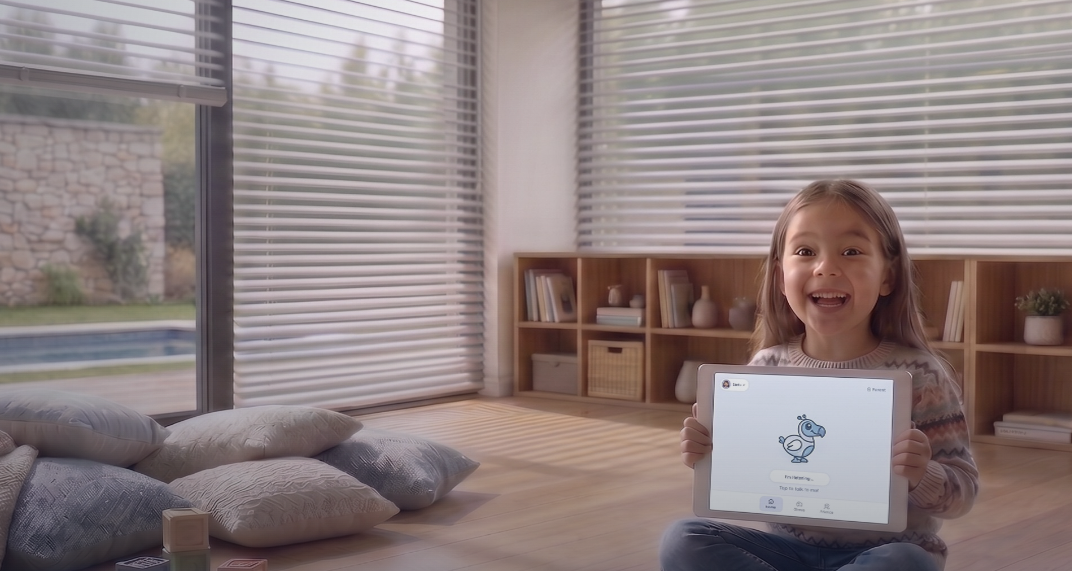
dodi is a voice-first learning companion. A child talks. It listens, answers, and plays. The point is not to replace the teacher or the parent. It is to give the child a patient partner for the kind of practice that does not fit on a multiple-choice card.
It starts from curiosity, not a script. Together you can invent a learning game on the spot: a maths dungeon about dinosaurs, a drawing quest, a story that only works if the child reasons out loud. Making the game is the creative act. Playing it is the rehearsal.
It remembers the child, not a generic grade band. After each session it updates what it knows: what they love, where they get stuck, how they like to be challenged. The next conversation can ask a better question instead of repeating yesterday's drill.
It stays on your side of the privacy line. Personal data and conversations are end-to-end encrypted. You can read, edit, or erase what it remembers. There are no ads and no selling of data. Critical thinking includes knowing who is listening.
It is open source. You do not have to take a company's word for how a tool around your kids behaves. The code is there to read, audit, or run yourself.
A small shift at home
You do not need to throw out school. You can change the ask:
- After an AI-written paragraph, ask your child what they would cut, and why.
- When a fact appears, ask how they would check it without the chat.
- When they are bored of a topic, build a tiny game about it together instead of another quiz.
That is the muscle. Recall still helps. Creation and judgement are what make it theirs.
If you want a companion that practises those two things with your child, the dodi app is free to start.